Five AI Experiments You Can Do in 10 Minutes That Teach You More Than Any Course
Most professionals trying to learn AI follow a familiar pattern. They enrol in courses, bookmark tutorials, collect prompt libraries, and save long videos they intend to watch later. For a while, this feels productive. There is a sense of progress and momentum, even though very little of it translates into practical capability.
When they try to apply what they have learned to real work, confidence is low and uncertainty is high. The tools feel impressive in demonstrations, but fragile in real environments. Outputs look plausible, but often lack context, accuracy, or relevance.
This is not a failure of motivation or intelligence. It is a failure of learning design.
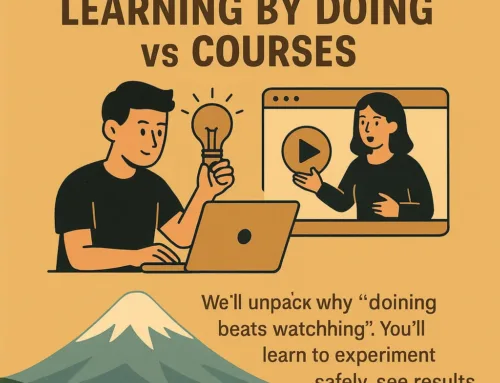
Most AI education is disconnected from daily practice. Watching someone else use a tool does not teach you how it behaves inside your systems, with your data, under your governance constraints, and in politically complex organisations. That understanding only develops through repeated, hands-on use.
Capability is built through small, practical experiments that fit into normal workdays. Not through long, idealised tutorials.
The following five experiments can each be completed in around ten minutes. When repeated consistently, they build more usable skill than most formal training programmes.
Experiment 1: Turn a Vague Problem Into a Working Brief
Most organisational work begins with unclear thinking. Phrases like “we need better reporting” or “leadership wants more insight” signal discomfort, not direction.
Take a vague problem you are currently dealing with and paste it into your AI tool.
For example:
“I need to improve how we report performance to leadership but priorities are unclear and nobody reads the outputs.”
Ask the tool to convert this into a structured brief that includes objectives, audience, constraints, and success measures.
Review the response carefully. Correct incorrect assumptions. Add missing context. Clarify scope. Refine language. Then run it again.
What you are learning here is not how to write briefs. You are learning how structure shapes reasoning, how incomplete input weakens output, and how much responsibility remains with the user.
This skill underpins every effective AI workflow.
Experiment 2: Test AI Against Your Own Expertise
Choose a process or domain you know well. It might be a compliance workflow, a customer journey, a reporting cycle, or a governance process.
Ask the AI to explain how it works.
Compare the output to reality. Identify what is missing, what is wrong, and what sounds plausible but is inaccurate. Then correct it and ask for a revised version.
This experiment develops calibration. You learn where the tool is reliable, where it generalises too aggressively, and where it substitutes probability for truth.
Without this habit, users drift into uncritical acceptance.
Experiment 3: Use AI to Challenge a Real Decision
Select a genuine decision you are currently facing. This might involve hiring, system investment, organisational change, or strategic direction.
Describe the situation and ask the AI to identify risks, weak assumptions, and likely failure points. Then ask what you may be underestimating and what evidence would reduce uncertainty.
The purpose is not to obtain answers. It is to surface structured doubt, alternative frames, and analytical prompts that improve decision quality.
Used properly, AI becomes a reasoning support system rather than a recommendation engine.
Experiment 4: Convert Daily Work Into Reusable Assets
Most professionals repeatedly recreate similar work: reports, proposals, emails, briefings, and updates.
Take something you have written recently and ask the AI to convert it into a reusable template. Then ask it to identify which elements vary and to design a quality-control checklist.
Over time, this process turns experience into infrastructure. It reduces cognitive load, improves consistency, and increases leverage.
This is where individual productivity gains compound into organisational capability.
Experiment 5: Design a Practical Workflow
Choose a recurring task and describe how it is currently performed.
Ask the AI to design a workflow that integrates automation and human judgement. Then ask where risks exist and where oversight is essential.
This experiment teaches systems thinking. It reveals how AI interacts with governance, accountability, and organisational realities. It prevents the common mistake of treating tools as isolated solutions.
Why These Experiments Work
Most AI training focuses on features, terminology, and future trends. This provides context but rarely changes behaviour.
Capability develops through repeated exposure to imperfect outputs, ambiguous inputs, and real constraints. These experiments force users to provide better information, validate results, correct errors, and apply judgement.
They compress learning into daily practice.
Ten minutes of applied use produces more durable learning than hours of passive instruction.
Making This Sustainable
No formal programme is required.
One small experiment per day. Applied to real work. Reviewed weekly.
Over time, this builds a personal library of tested workflows, templates, and heuristics. Confidence becomes grounded in evidence rather than familiarity with terminology.
The Larger Pattern
AI is not a subject to master. It is a capability that develops through use.
The professionals who succeed with it are not those who follow trends most closely. They are those who quietly experiment, reflect, and refine their approach over time.
They build systems.
They build evidence.
They build trust in their own judgement.
That is what scales.
At Changeable, this is how we approach AI adoption. We focus on practical workflows, governance, and decision support embedded in real organisational contexts. Not hype. Not theatre. Not dashboards without purpose.
Just systems that work.