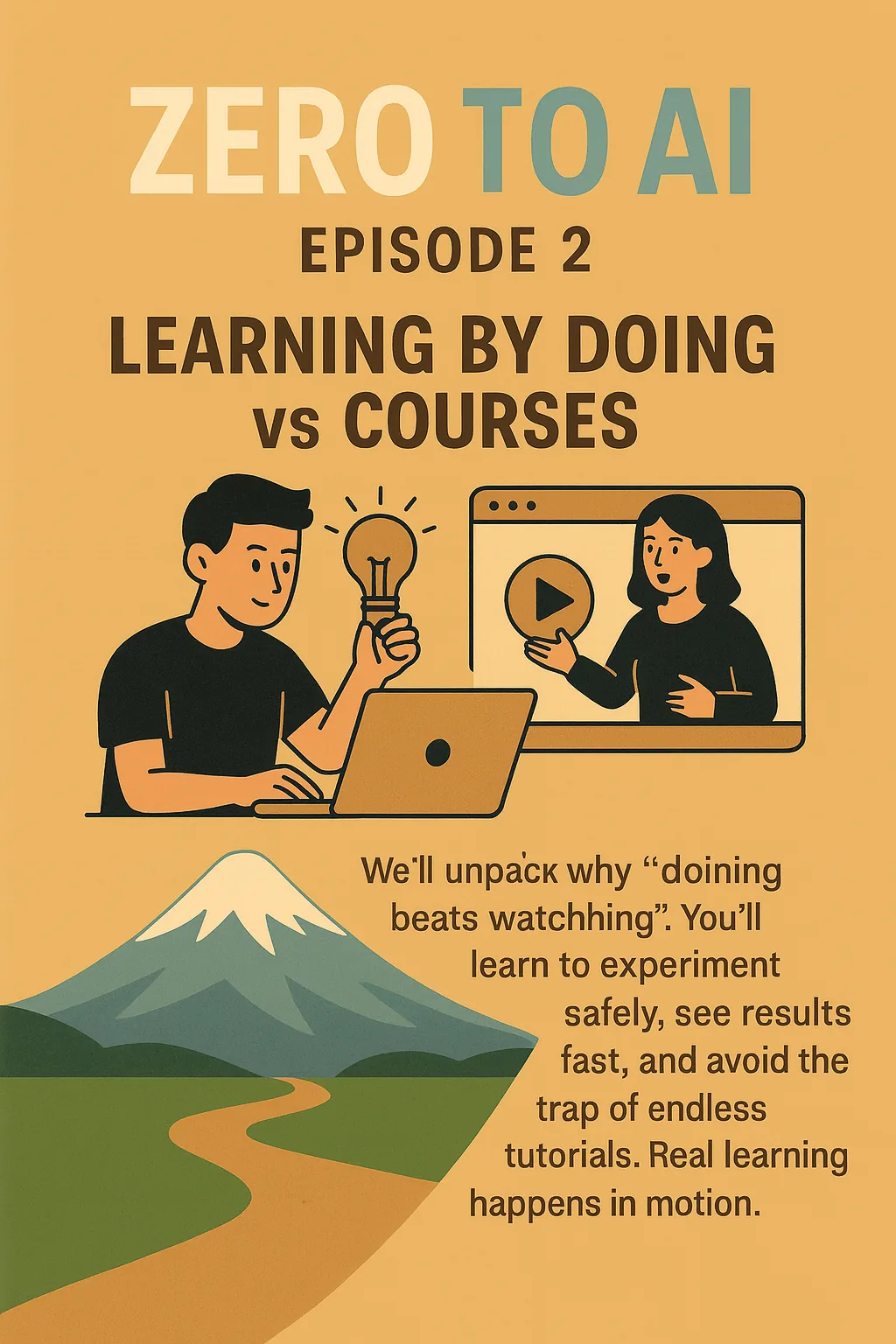
Zero to AI — Episode 2: Learn by Doing vs Courses
Hi everyone, and welcome back to Zero to AI. where we explore what it really takes to learn, build, and reinvent your career with AI — one honest story at a time.
This is week two in our year journey of AI transformation and reinvention. Today, I want to talk about a video that absolutely changed how I think about work — and honestly, how I think about myself.
It’s a YouTube video that explains why smart, capable people like us often get stuck in planning mode… endlessly strategising, learning, researching, and mapping things out — but not actually shipping the work. It introduced a concept called The Strategist vs The Performer — and it hit me like a freight train.
Because I realised: I’ve been training my strategist for years… and I’ve forgotten how to perform.
Why this video mattered so much to me
I’m not exaggerating when I say this video flipped my mindset completely.
For a long time, I’ve been working hard on perfecting my Strategist — the part of me that plans, analyses, maps out strategies, and builds roadmaps. And that’s fine in big organisations. In those environments, you can rely on implementation teams to execute. But in my world now — running two new brands, Changeable and Zero to AI — I am the implementation team.
The problem was, I’d built so much strength in strategy that I’d neglected performance. And when I had to perform, I froze. I felt fear — fear of failure, fear of wasting time, fear that the output wouldn’t be good enough.
So what did I do instead? I did what I do best — I learned more, I researched more, I planned more. I created more strategy documents. And none of it actually moved the work forward. So, what the video taught me about the trap of intelligence
Here’s the core message of the video:
When we’re young, we’re naturally performers. We try things, we fail, we get back up. But as we get smarter, and especially as we succeed, we start to value strategy more than action. We spend more time thinking, planning, researching, and preparing — and less time doing. The creator of the video calls this the Strategist vs Performer problem.
The Strategist works in safety — researching, learning, planning.
The Performer works in uncertainty — doing, failing, learning through motion.
And over time, the Strategist gets stronger while the Performer gets weaker. That hit me hard because it perfectly described my last few years. I was proud of being smart, analytical, methodical. But when it came time to execute? I stalled. And that’s when I realised — intelligence can become a trap if it’s not balanced with action.
Rebuilding my performer
So I started working on my Performer. I started small — and I mean really small. I focused on quick wins. I broke big goals into smaller, bite-sized chunks that didn’t feel overwhelming. I created micro‑tasks that I could finish in 10 or 15 minutes — not big projects that scared me. And when I made mistakes — which I did, often — I stopped treating them as failures.
I started treating them as data.
Because the truth is, most of my biggest breakthroughs came after I messed something up. Mistakes are just feedback loops. They tell you what doesn’t work so you can get closer to what does. That shift changed everything.
When learning became a tool, not a hiding place
The video says something brilliant — stop watching, stop learning, stop strategising endlessly. Start doing. And I did. But then I hit another barrier — sometimes, I genuinely didn’t know enough to complete the next step. And that’s where my Strategist tried to sneak back in. It whispered, “Let’s do another course. Let’s go study this properly before you try again.” But instead of falling back into that trap, I used what I call Just‑In‑Time Learning.
I only learned what I needed right now to complete the next task. Not a full course. Not ten YouTube tutorials. Just the one thing that would unlock the next action. That made learning a tool for empowerment — not avoidance.
How AI helped me perform again
Then something really interesting happened. I started using ChatGPT as a partner — not as a search engine, but as a co‑performer. would say, “Here’s what I want to achieve. Give me the exact steps.” And then I’d just follow the steps — like a dance partner leading me through the moves.
If I got stuck, I’d send a screenshot or describe the issue, and we’d fix it together. It was learning and performing at the same time. And because the guidance was immediate, I never got stuck long enough to lose momentum. That was the moment I realised — my Performer wasn’t gone. He was just out of shape. And this process was rebuilding his strength.
The new balance: Strategist + Performer working together
These days, I see them as a partnership. The Strategist designs systems — frameworks, checklists, templates — that make it easier for the Performer to act.
The Performer takes those systems and executes, learns, and reports back.
Then the Strategist simplifies things even more.
It’s a feedback loop. A collaboration. And honestly, it’s changed not just how I work — but how I feel about work. I’m no longer waiting to feel ready. I act while I feel nervous. And every time I do, the fear shrinks and the confidence grows.
The takeaway: Strategy means nothing without action
The video ends with a line that sums it all up: “Don’t fight it. Work with it. Create a plan that prepares you for performance.”
That’s the lesson I took to heart. The Performer never feels ready — and that’s okay. Your job isn’t to remove the nerves; it’s to act while they’re there. If you only take one thing from this episode, let it be this:
- Open a blank document.
- Type for three minutes.
- And hit publish somewhere safe.
- That small act of doing — that’s how you start rebuilding your Performer.
If you haven’t already, go watch the video that inspired this episode. It’s one of the best pieces of content I’ve seen this year — and it might just unlock something in you too.
Next we will be looking at how this has changed my approach and philosophy from certificates to shipped work, where I will introduce a framework that will enable you to do the same.
This part of today’s episode is called “From Certificates to Shipped Work.” It’s about that moment when learning stops being something you study — and becomes something you live.
The Confession
About six months ago, I’ll be honest… I didn’t really get AI. Not properly. Sure, I knew the buzzwords. I could drop “large language model” into a conversation and sound like I knew what I was talking about. ut if you’d asked me to build something — anything — I would’ve frozen. So, I did what most of us do. I took courses.
And they were good. Actually, they were better than good — they were necessary. They gave me vocabulary. They gave me context. They gave me the confidence to talk about AI without feeling like I was bluffing.
They lit the spark — that thought of, “Hey, maybe this could be part of my next chapter.” But here’s what happened next.
I kept learning. Then I learned some more. Then I started stacking certificates. And even though it felt productive — even though I was proud of that progress — something was missing. Because when I sat down to actually do something… ship a workflow, automate one process, fix one real problem… I still couldn’t. I knew about AI. But I didn’t yet know how to use it.
Then came the realisation
This isn’t a dig at courses. I still think they’re important. But at some point, I realised: knowledge wasn’t the missing piece. Transfer was. I needed a way to move from knowing about AI to using AI — to build something that worked in my world. So I flipped my learning plan on its head.
Instead of treating courses as the path, I started using them as fuel. I stopped optimising for certificates… and started optimising for outcomes. And once I shipped my first small thing — and saw it work — I was hooked.
It wasn’t pretty. But it worked. And that feeling — that first click of something I built doing something useful — was addictive.
The Flip — Learning by Doing
Now I learn by building.
The tool I used to study became the tool I used to create. The model I used to ask questions became my co pilot. AI stopped being a topic and started being a partner — my mentor, my critic, my debugger, my planner. I wasn’t doing homework anymore. I was shipping. And the learning happened inside the shipping.
So if you’re listening to this and you’ve been stacking courses… maybe pause and ask yourself: what’s one tiny thing you could build today? Because that’s where the real learning starts.
Phase 1 — Courses Are the Spark, Not the Destination
Here’s what courses gave me — and what they’ll give you, too:
- Language — words like “prompt,” “context window,” and “embedding.” Labels matter. They help you think.
- Maps — they show what AI is good at, where it struggles, and what “good enough” looks like.
- Examples — little toy problems that make things less scary.
- Community — a reminder you’re not the only one fumbling through the fog.
- If you’re at zero, start here. But then set a finish line. Take one or two solid courses, then stop.
- If you keep stacking certificates, you’ll accidentally build an identity around learning — not building.
- The next skill you need only comes from touch — fingers on keys, brain in flow, heart slightly racing.
Phase 2 — Learning as Doing
Here’s how I flipped the script. I picked one tiny project that mattered to my day. Not a big idea — just something that annoyed me. Maybe it’s sorting routine emails. Or cleaning up meeting notes. Or turning form responses into a spreadsheet.
- Then I gave myself 90 minutes.
- I aimed for ugly and working, not pretty and perfect.
- When I hit a wall — and I always do — I didn’t dive back into another course. I did Just In Time Learning — 10 minutes, one question, one answer, straight back to building.
- By the end of that week, I had three tiny things that actually worked.
- They weren’t elegant — but they were mine. And that’s the click. That’s when learning lands as proof.
The Reflection Loop
Now, this is where most people lose momentum — they do, but they don’t reflect. Reflection turns doing into progress. I use a simple log — same prompts every time:
• What worked?
• What didn’t?
• What did I learn?
• Did I keep my commitment?
• What’s next? One action. One owner. One date.
Takes two minutes. And that’s it. That pattern — build, reflect, tweak — compounds faster than any course I’ve ever taken.
AI as Your Partner in Crime
Once you start shipping, something cool happens. You stop asking, “What should I learn next?” and start asking your tools:
• “Here’s my input and output — what’s the smallest path between them?”
• “This broke — show me the fix.”
• “Critique my prompt; make it more resilient.”
• “Explain this error like I’m five.”
That’s when the tool becomes your teacher.
AI becomes your:
• Teacher — explaining micro concepts in your context.
• Mentor — helping you scope and sequence.
• Analyst — spotting risks.
• Critic — finding your blind spots.
• Troubleshooter — debugging your messes with infinite patience.
And suddenly, learning is alive — because it’s yours.
The 14 Day Starter Plan
Alright — here’s the practical bit.
If you want to test this approach, try the 14 Day Starter Plan.
• Day 1: Pick one tiny project that matters to your day — email, calendar, notes. Write your success line in one sentence.
• Day 2: 90 minute build. When blocked, do 10 minutes of JITL. Ship something tiny — even if it just prints “hello.” Log it.
• Day 3: Add one feature. Log it.
• Day 4: Record a 90 second demo — no polish. Share with one person you trust.
• Day 5: Tidy one sharp edge — rename, comment, document.
• Day 6: Rest or read one doc that unlocks next week.
• Day 7: Write a 200 word recap — what worked, what didn’t, what you learned.
• Days 8 14: Repeat or extend. Aim for 4 6 shipped slices total.
That’s it. Two weeks. Small, consistent, real.
Let me share a couple of examples.
Firstly, the building the Zero to AI Brand from Scratch
Alright — so first example. Zero to AI wasn’t just an idea that came fully formed one day. It started as a single post. I’d been talking with friends about my mid-career pivot, this feeling of wanting to combine everything I’d learned from 20 years in digital and business analysis with this new world of AI. But instead of over-planning or overthinking, I decided to test something small.
Day 1: My goal was simple: write one story post that explains what Zero to AI means and why it exists. No website, no logo — just words. That one sentence became my anchor: “If I can explain it clearly, it’s real enough to share.”
Day 2: I opened Notion, wrote a rough version, and used ChatGPT to help shape the tone. I gave it this prompt:
“You’re my writing collaborator. Turn this into a warm, honest reflection about shifting from digital agency life to learning AI. Keep it simple and real.” Ninety minutes later, I had a story that felt true. Not perfect — but me.
Day 3: I wanted to make it feel tangible. I used my Changeable design system to make a logo and colour palette. Warm tones, rounded shapes, 2D illustrations — that style you now see across everything Zero to AI.
Day 4: I recorded a short Loom walkthrough of the Notion workspace — just me talking through my idea. I sent it to a friend. He messaged back: “Mate, this feels real now.” That one bit of encouragement kept me going.
Day 5: I tidied up the design — fonts, layout, brand card — and wrote down my tone guide: empathetic, honest, storytelling.
Day 6: I took a rest day, but later skimmed through Story Brand. The takeaway that stuck: “Show transformation, not service.” That line changed how I write everything now.
Day 7: I wrote a reflection in my log: “Lowering the bar made it possible to start. Perfection would have killed this before it began.”
Days 8–14: Over the next week, I wrote three more posts, built a small About page, and drafted the intro to the Zero to AI podcast — yes, this one you’re listening to.
By Day 14, I didn’t have a full brand yet — but I had momentum. A story that people resonated with. A rhythm. A voice. And that’s when I realised: a brand isn’t a website — it’s a rhythm of creation. One loop at a time.
The second example involves the development of a Financial and Supply Chain Forecasting System for a Manufacturing Business
Now, the second example is from my consulting work — and it’s a good one because it shows how small projects can have real-world impact.
A local manufacturing business had this constant problem. They couldn’t see clearly what components they needed to order for the next production cycle. They were over-ordering some parts, under-ordering others, and running into cash flow crunches. Classic growing pains.
Day 1: I defined the goal in one line:
“Build a simple spreadsheet that forecasts next month’s production requirements, component usage, and cash flow based on past data.”
It wasn’t fancy — just clear. Something achievable.
Day 2: I blocked out 90 minutes and pulled their last three months of production and purchase data into Google Sheets. Then I used ChatGPT to help me structure it.
I wrote: “Design a basic forecasting sheet for a small manufacturer with columns for production volume, supplier lead times, and material costs.”
By the end of that session, I had a working table: sales by week, lead times, and cost formulas that projected the next month’s component needs.
Day 3: I added one feature — a simple cost-of-goods calculator. That turned it from a tracking tool into a real decision-making tool.
Day 4: I recorded a quick Loom video walking through the sheet. Sent it to the operations manager.
He replied: “This will save me hours every week.” And that’s when I knew it worked.
Day 5: I tidied the formatting, added dropdowns for product lines, and colour-coded risk levels — green for on target, red for shortfall. It started to look and feel like a product, not just a spreadsheet.
Day 6: I took a break, then read a short guide on manufacturing operations. The key takeaway? Use rolling averages instead of static monthly targets. That one tweak made the whole system more realistic.
Day 7: My reflection that day was simple: “The difference between theory and value is visibility. You can’t optimise what you can’t see.”
Days 8–14: The next week, I added automation and a sprinkle of AI:
• A GPT-powered column that summarised anomalies (like, “Production dip due to supplier delay”).
• A Google Apps Script that automatically emailed a weekly summary to the finance team.
• A live feed that updated supplier prices.
• And a simple 3-step runbook that anyone could follow.
By Day 14, they had a working system — not a pilot, not a prototype, but something that saved five hours a week and helped them plan better.
Lesson learned: Real optimisation starts with clarity. Build visibility first, automation second.
The switch flip
If you stick with this for two weeks, you’ll feel a gear shift. You stop identifying as a learner… and start feeling like a builder. Your confidence grows not because you know more — but because you see results.
Courses gave me belief. The loop gave me proof.
My challenge for you
So here’s my challenge for you this week: pick one small problem in your day. Give yourself 90 minutes. Use AI as your co pilot. Build, reflect, ship.
Your tools can become your teachers — and your certificate can become something that works in the real world.
That’s how you go from Zero to AI — one shipped slice at a time.
If this episode resonated with you, share it with someone who’s been stuck in planning mode. If your business needs assistance, visit www.changeable.co.nz. And remember: thinking gets you started — doing gets you there.
This has been Zero to AI. I’m Steve Wilson — thanks for joining me.