Why one page beats thirty slides
If your monthly report needs snacks and an intermission, people won’t read it—they’ll respect it from a safe distance. A one-page narrative flips that. It says: “Here’s what changed, why it matters, and what we’ll do next.” Busy brains cheer. Decisions happen sooner. Meetings shrink. And you look like the person who can turn noise into signal (which, between us, is half of leadership).
Think of numbers as ingredients. On their own, they’re raw carrots. Your job is the soup: warm, digestible, and seasoned with context. One page forces clarity. No data dumps. No chart salad. Just the useful bits, told simply.
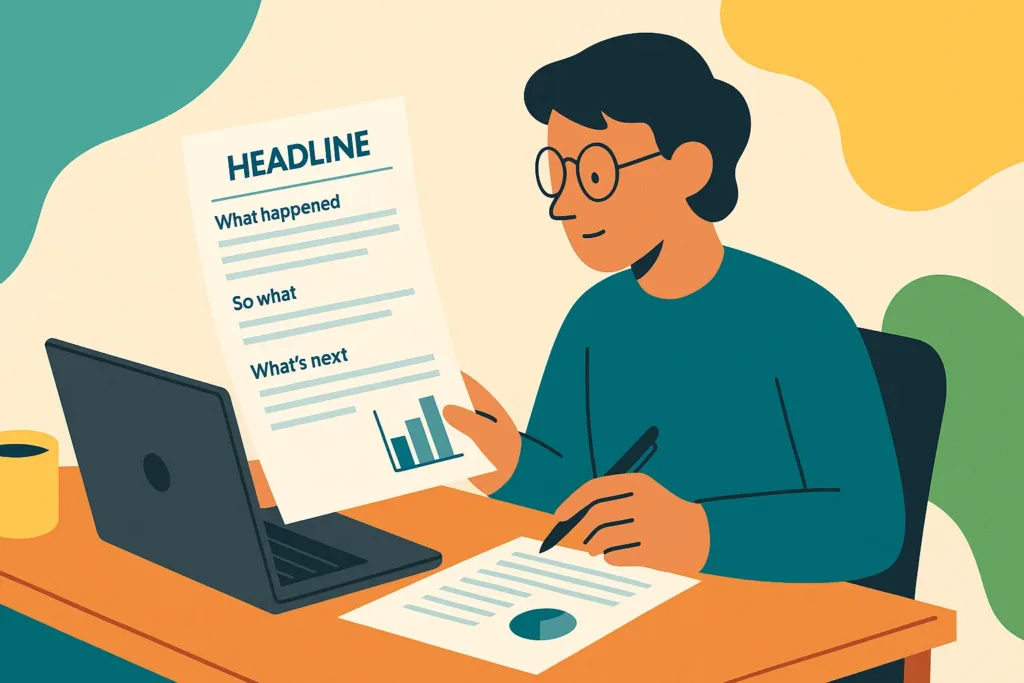
What your one-pager includes
Keep the structure steady so readers know where to look each month.
- Headline — the big thing that changed (up, down, flat) and why.
- What happened — two short paragraphs that tell the story.
- So what — a few sentences that translate impact for your audience.
- What’s next — the decision you recommend, with an owner and date.
- One visual — the single chart or tiny table that earns its spot.
- Footnote — where the data came from and any caveats.
That’s it. If it won’t fit, it probably doesn’t belong—or it belongs in an appendix for people who enjoy second helpings.
The simple writing recipe (VALUE + 4Q)
Before you write, ask the VALUE questions:
Value: What outcome matters here? (revenue, cost, satisfaction, risk)
Audience: Who’s reading this and what do they care about?
Limits: Any rules? (privacy, sensitivity, wording)
Useful inputs: Which numbers/comments/examples actually help?
Evaluation: How will we know this is good enough to ship?
Then run your draft through the 4Q Review:
Accurate? Names, dates, amounts right?
Clear? Understandable on the first read by a time-poor human?
Complete enough? Anything vital missing?
Kind? Tone respectful and fair?
If one box fails, fix that one thing and ship. Perfection is a hobby. We’re here for progress.
Real-world examples — Accountant (SME clients)
Situation: Monthly packs go out; clients skim the graphs and email questions you already answered on page eight
One-page version:
• Headline: “Margins steady despite freight jump—two levers kept us flat.”
• What happened: Freight rose 7%; upsells and a small price tweak offset most of it.
• So what: Cash is tight in week three; watch overdue invoices.
• What’s next: Owner calls top five debtors by Thursday; trial delivery-window change for two low-margin SKUs.
• Visual: Tiny table showing margin %, freight %, and average invoice age this month vs last.
Win: Clients read it, act on it, and stop sending “quick questions” at 9:47 pm.
Real-world examples — Operations Lead (warehouse + support)
Situation: You ship a status deck no one loves and everyone fears.
One-page version:
• Headline: “On-time shipments up 6 pts; one supplier causing most delays.”
• What happened: Two packing tweaks sped things up; Supplier K late 5/8 times.
• So what: Customer wait time trending down; tickets about delays down 18%.
• What’s next: A/B test earlier cut-off this week; escalate Supplier K with a shared dashboard.
• Visual: Small line for on-time % (6 weeks) + one column for Supplier K exceptions.
Win: Teams coordinate without a 16-slide therapy session.
Real-world examples — Project Manager (construction site)
Situation: Weekly updates turn into novels with surprise plot twists.
One-page version:
• Headline: “Scope stable; weather stole two days—handover still on track.”
• What happened: Rain paused exterior works; interior progress offset.
• So what: Risk nudged from low → medium; costs steady.
• What’s next: Saturday shift (approved); roofers Monday 7 am; supplier confirm Friday 12 pm.
• Visual: Micro-Gantt for five critical tasks.
Win: Stakeholders feel informed, not cornered. Fewer “just checking” calls.
How AI (yes, ChatGPT) makes this way easier — analysis + layout
Think of AI as your report sous-chef. You still own the taste and the plating; it just chops onions and washes pots at cartoon speed.
Financial analysis by prompting (no spreadsheets harmed)
You bring the numbers; AI helps you spot the story.
How to do it (simple):
1) Copy the key figures you plan to use (revenue, margin %, freight %, invoice age…).
2) Add one sentence of context: who it’s for and what decision you want.
3) Ask for a short narrative and 1–2 “why this changed” hypotheses.
4) Ask for exactly one visual idea that makes the point clearer.
Copy-paste prompt (edit the [bits]):
“You are my reporting buddy. Audience: [owner-operator, time-poor, hates jargon]. Goal: a one-page monthly narrative that leads to a decision.
Numbers: [paste small table or bullets].
What changed vs last month? Give me 3–5 sentences explaining the ‘so what’ in plain English, then list 2 plausible reasons (no certainty claims).
Suggest exactly one simple chart or tiny table to support the headline.”
Optional follow-up:
“Trim to 120 words. Keep NZ spelling. Replace any jargon. Start with the headline.”
Let AI sketch the page layout (you still approve)
You’ve got the content; now make it tidy without an hour of formatting.
How to do it:
1) Tell AI your structure: Headline → What happened → So what → What’s next → One visual → Footnote.
2) Paste your draft.
3) Ask it to reflow with clear headings and short paragraphs, plus a visual placeholder.
4) Paste into Word/Docs and give it a human polish.
Prompt:
“Reformat into a single A4 page with sections in this order: Headline (1 sentence), What happened (2 short paragraphs), So what (3–4 sentences), What’s next (2–4 sentences with owners+dates), One visual (describe), Footnote (1 line on data source).
Keep it concise, plain English, NZ spelling. No bullet explosions, no jargon. Here’s the draft: [paste].”
Tiny chart decision help:
“Choose one: small line (last 6 weeks on-time %), or tiny table (margin %, freight %, avg invoice age this month vs last). Which best supports the headline and why?”
Delegation without drama
• To yourself: “Draft me a board version (formal) and a team version (friendly).”
• To colleagues: “Turn this into our template: same sections, our tone, and a sample visual.”
• To Future-You: “Remind me of last month’s headline and the metric we said we’d watch.”
Sanity check (the one rule we keep)
AI drafts. You check names, dates, amounts, and tone. Run the 4Q Review (Accurate, Clear, Complete-enough, Kind), tweak a line, ship. If it feels off, it probably is—fix that bit and move on.
Friendly kicker: if your one-pager makes a smart person nod on the first read, that’s a win. If it also shortens a meeting, that’s a biscuit.
Common traps (and friendly fixes)
Trap: Twenty charts.
Fix: One chart that earns its page rent. If a visual doesn’t change a decision, it’s scenery.
Trap: Jargon stew.
Fix: Pretend you’re explaining it to a smart friend from another team. If you wouldn’t say “QTD YoY delta uplift,” don’t write it.
Trap: Blame-flavoured paragraphs.
Fix: Describe the system, not the villain. Recommend a next step. Your tone builds trust.
Trap: No clear ask.
Fix: End with one decision and a date. “Pause spend on X for two weeks while we test Y—approve by Tuesday.”
A copy-paste one-page template
Use this exactly once… then make it sound like you.
Title: Month — Team/Client — Focus (e.g., “August — Finance — Margins & Cash”)
Headline (one sentence):
What changed and the simplest reason.
What happened (2–3 short paragraphs):
Tell the story in plain English. Mention only the metrics that matter. Compare to last month/quarter if it helps.
So what (2–4 sentences):
Translate impact for your audience—money, risk, satisfaction, speed. Keep it human.
What’s next (2–4 sentences):
The decision or action, the owner, the date. If you’re waiting on someone, name them kindly.
Visual (one small chart or table):
Label clearly. Legend optional. No rainbow explosions.
Footnote (one line):
Data source(s) and caveats. “Sales from Xero; excludes wholesale. Forecast assumes avg lead time.”
This week’s tiny plan
Pick one upcoming report and quietly replace the executive summary with the one-page version. Don’t announce a revolution. Just send it. Ask two readers, “Was this clearer? What was missing?” Tweak it once and repeat next month. After three rounds, you’ll have a rhythm, a template, and an inbox full of “this is so much easier” messages. Frame one for your desk if you’re that way inclined.
Final word
Numbers don’t speak for themselves; they mumble. You’re the translator. With a steady one-page format, a friendly voice, and a dash of AI for the heavy lifting, you’ll help people see what matters, choose faster, and feel calmer. That’s real value—and it’s absolutely in reach this month.