
Why this matters (farmer-to-farmer, no fluff)
There’s a lot going on in farm life: weather that can’t make up its mind, fences that pick the worst day to fail, suppliers ringing, staff questions, SCC behaving like a yo-yo, and paperwork that reproduces overnight. In all that noise, AI often gets misunderstood as “tech for city folks” and quietly ignored.
Here’s the truth: you don’t need to love technology to like results. Used well, AI is just a very fast note-taker and planner that turns your rough paddock notes, emails, and costs into simple, practical actions. We’re talking minutes of effort for hours saved, steadier grazing, smarter timing on fert, fewer “oops, forgot” moments—and yes, a better bottom line.
• Productivity: clearer rotations, fewer surprises, quicker decisions.
• Efficiency: less double-handling, fewer wasted trips, tighter timing.
• Profitability: spend where it pays, cut what doesn’t, act early instead of late.
No robots in the shed, no new hardware. Phone or computer, that’s it. You type or paste a few lines; it gives you a tidy plan, a short summary, or a sensible “do this next.” If it doesn’t save you time or money, we bin it. If it does, we keep it and make it a habit. Simple.
We’ll walk through Beginner, Mid-track, and Advanced options so you can start where you’re comfortable and move up only if it’s worth it. Bring your real farm notes, not perfect data. We’ll keep the language plain, the steps small, and the wins obvious.
First things first: the tool & how to use it
We’ll use ChatGPT as your “helpful farm notetaker and planner.” It turns your notes into plans, tidies emails, and spots patterns. No tech degree needed.
How to open it (choose one):
• On your phone: Install the ChatGPT app from the Apple App Store or Google Play. Open the app and sign in.
• On your computer: Open your web browser and go to the ChatGPT website. Sign in.
How to use it:
1) Open ChatGPT.
2) Tap/click the message box at the bottom.
3) Paste or type what I show you below (the exact words).
4) Read the result, make small edits if you like, and save/share/print.
Note: If your farm already uses Microsoft 365 or Google Workspace, you can do the same tricks inside Copilot (Word/Outlook) or Gemini (Docs/Gmail/Sheets). But to keep things simple, we’ll show everything with ChatGPT.
BEGINNER (30–60 minute wins, no jargon)
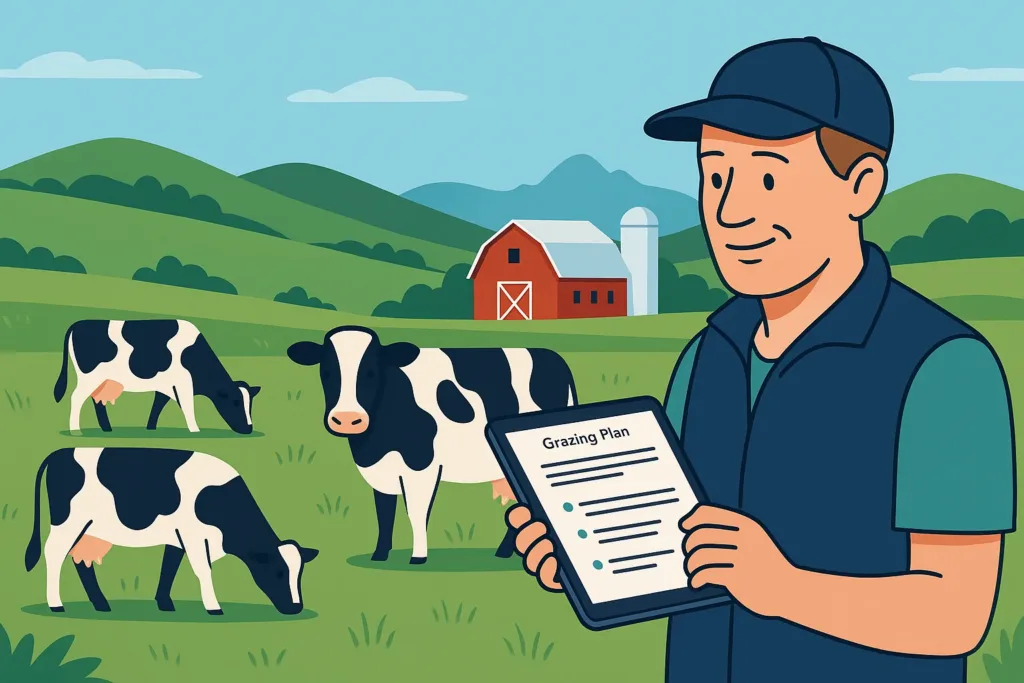
1) Turn a paddock walk into a 7-day rotation plan
Tool: ChatGPT (phone or computer)
How (step-by-step):
1) After your paddock walk, dictate a short note on your phone (paddock names, covers if you have them, any wet bits).
2) Open ChatGPT.
3) Paste this text and fill the [bits]:
I’m a NZ dairy farmer. Herd size [###], target residual [e.g., 1500–1600], paddock notes: [paste your notes]. Make a simple 7-day grazing plan: paddock order, break sizes, and one short reason for each choice. Keep it practical and brief.
You get (what it looks like):
• A day-by-day list: “Mon—P6 (2 breaks of 0.9 ha)… reason: stronger cover, dry underfoot.”
• Break sizes and one-line reasons (easy to read over the bike tank).
• A short “watch-outs” line (e.g., “rest Paddock 3 an extra day”).
Why it matters (impact):
• Time saved: 15–30 minutes of fiddling → plan done.
• Steadier residuals: better regrowth, fewer costly top-ups later.
• Smoother team handover: everyone follows the same plan.
2) Turn messy supplier emails into clear actions
Tool: ChatGPT
How:
1) Copy the supplier email text (feed/fert/repairs).
2) Open ChatGPT, paste, then type:
Summarise this in plain English for a dairy farm. List price per tonne/kg N (if relevant), delivery dates, and the actions I need to take by when. Keep it to 6 lines.
You get:
• A short summary, prices, dates, and a to-do list (“Approve by Thu 3pm”).
Why it matters:
• Fewer missed dates, cleaner cost comparisons, and less head noise.
3) Make a simple roster & job cards
Tool: ChatGPT
How:
1) Type a quick list of jobs + who’s available.
2) Paste this:
We have [2/3] people: [names or roles]. Jobs this week: [list]. Make a daily roster that reduces back-tracking. Add short safety notes for each job. Keep it short and printable.
You get:
• A day-by-day roster with who, what, and simple safety notes.
Why it matters:
• Less running around, clear handovers, and fewer “Did that get done?” chats.
MID-TRACK (use a bit of data you already have)
1) Rotation planning with basic numbers
Tool: ChatGPT
How:
1) Grab what you have: rough covers, herd size, target residual, this week’s weather.
2) Paste:
Herd [###], target residual [###], pasture covers: [paste rough list], weather: [short note]. Suggest a 10-day rotation with break sizes. Flag any paddocks that should rest longer or be grazed earlier, and explain why in one line each.
You get:
• A 10-day plan, break sizes, and flags (“Rest P7 longer—wet slope; bring P2 forward—going to seed”).
Why it matters:
• More even residuals → better regrowth → fewer supplement shocks.
2) Fertiliser timing & spend sanity-check
Tool: ChatGPT
How:
1) Note the last fert dates, soil test summary, and current price per kg N.
2) Paste:
Last N dates: [list by paddock]. Soil test summary: [short bullets]. Price per kg N: [$]. Rain window likely: [e.g., 3–5 days]. Give 3 options: maintain, reduce N 10%, or delay 2 weeks. For each, list pros/cons and likely impact on growth and cost. Say which you’d choose and why, in plain English.
You get:
• Three clear options with pros/cons, a recommendation, and simple reasoning.
Why it matters:
• You time fert for response, not habit. That’s money not wasted.
3) Health patterns (SCC, mastitis)
Tool: ChatGPT
How:
1) List bulk milk SCC by week, mastitis cases by paddock, and any wet/cold snaps.
2) Paste:
Bulk SCC by week: [numbers]. Mastitis cases + paddocks: [list]. Weather notes: [short]. Spot any patterns. Suggest 2 prevention actions we can try this fortnight, with cost and effort noted (low/med/high).
You get:
• A pattern summary and two concrete prevention steps (“Rubber mat at entry—low cost; adjust wash routine—low effort”).
Why it matters:
• Lower milk loss, fewer treatments, fewer sick days for cows.
4) Simple spend monitor (feed & fuel)
Tool: ChatGPT
How:
1) Paste last and this month’s feed/fuel/repairs spend (even rough).
2) Paste:
Compare these two months’ costs: [paste simple list]. Where did we overspend? Give one practical change for next month and a 1-line reason.
You get:
• A “here’s where it crept up” and one doable fix.
Why it matters:
• Small trims, every month, add up.
ADVANCED (connect dots, still plain English)
1) 90-day season forecast (production + cash)
Tool: ChatGPT
How:
1) Paste last 12 months’ milk curve, herd size, feed plan, average pasture growth, and likely milk price range.
2) Paste:
Forecast the next 90 days: best-case, expected, worst-case for production and cash. List the 3 biggest levers and the trigger points. Keep it simple and practical for a dairy farm in NZ.
You get:
• Three scenarios, clear levers (“if covers < X by date Y, buy Z tonnes”), and trigger points.
Why it matters:
• You act early with confidence, not late with panic.
2) “What if” feed plan chooser
Tool: ChatGPT
How:
1) List supplement options with price and ME, your rotation, and contractor availability.
2) Paste:
Compare 3 feed plans by cost per kgMS and risk (wet/dry conditions). Recommend one for current conditions and say why in one paragraph.
You get:
• A side-by-side choice with cost per kgMS and a plain recommendation.
Why it matters:
• You choose with numbers + common sense, not guesswork.
3) “Where should I focus this month?” (paddock targets)
Tool: ChatGPT
How:
1) Paste rough growth by paddock, fert history, and any problem notes.
2) Paste:
Choose 5 paddocks that will give the best return on attention this month and say why. For each, suggest one action and the expected benefit in one sentence.
You get:
• A short hit-list: where to spend time and what to do (not 40 maybes).
Why it matters:
• Effort goes where it pays. That’s productivity and profit.
Real Kiwi examples (start small, stack wins)
Example A — Rotation & feed (Beginner → Mid)
• You record quick notes → ChatGPT makes a 7-day plan with break sizes and reasons.
• Add covers and weather → it flags paddocks to rest or bring forward.
• Outcome: More even residuals; ~0.3–0.5 kgDM/cow/day less wastage. Across the herd, that’s real dollars.
Example B — Fert timing (Mid)
• You paste dates, soil test, price, rain window.
• You get 3 options with a pick and why.
• Outcome: Better response per dollar, less leaching risk.
Example C — SCC & mastitis (Mid)
• You paste SCC trend + paddocks + weather.
• You get two prevention steps to try this fortnight.
• Outcome: Fewer cases → less milk loss, less treatment cost.
Example D — Cash & feed (Advanced)
• You paste price range, feed quotes, expected growth.
• You get best/expected/worst with triggers (buy/hold).
• Outcome: Early, calm decisions, not rushed expensive ones.
Prompts you can copy (edit the [bits])
Rotation plan (Beginner)
I’m a NZ dairy farmer. Herd [###], target residual [###]. Notes from paddock walk: [paste]. Make a 7-day grazing plan: paddock order, break sizes, and a one-line reason for each. Keep it short and practical.
Fert timing (Mid)
Last N by paddock: [list]. Soil tests (summary): [bullets]. Price/kg N: [$]. Rain window: [dates]. Give 3 options: maintain, reduce 10%, delay 2 weeks. List pros/cons and likely impact. Pick one and explain in plain English.
SCC pattern (Mid)
Bulk SCC by week: [numbers]. Mastitis cases + paddocks: [list]. Weather notes: [short]. Spot any patterns and give 2 prevention steps we can try this fortnight, with cost/effort noted (low/med/high).
90-day forecast (Advanced)
Herd: [###], last 12 months milk curve: [brief], average pasture growth: [#/day], feed plan: [summary], milk price range: [$A–$B]. Forecast next 90 days (best/expected/worst). List top 3 levers and trigger points.
Tools you already own (and don’t need to change)
- ChatGPT on your phone or computer (as above).
- Your existing spreadsheet or farm software (for numbers you already track).
- Your phone camera for quick photos (fences, troughs, residuals) and voice notes.
Start with one simple workflow this week (rotation notes → plan). Do it again next week. When it’s easy, add one mid-track job (fert timing or SCC pattern). In a month, try one advanced “what-if” for cash and feed.
Effort vs payoff (honest view)
- Beginner (1 hour setup): Save 1–3 hrs/week on admin and planning.
- Mid-track (2–3 hours setup): Steadier production, tighter fert/feed spend.
- Advanced (half-day setup): Cleaner cash decisions, fewer expensive surprises.
Final word
You don’t have to love tech. You just have to like results. ChatGPT turns your rough notes into tidy plans, points out patterns, and keeps you ahead of the “uh-oh” curve. More time, steadier production, better profit — and maybe an earlier knock-off on Friday. If you want, I can bundle this into a printable shed poster and a set of one-tap prompts on your phone.