Zero To AI Episode 14: The Efficiency Audit
The Efficiency Audit
Week 14: How to Measure and Document Your AI-Driven Productivity Gains
By Steve – Zero to AI
Last week, you built something impressive. Your signature AI-assisted project. Something portfolio-worthy that you can actually show people.
This week? You’re going to prove it’s not a one-off.
You’re going to measure and document your AI-driven productivity gains.
And here’s why this matters.
When you walk into a performance review, or a salary negotiation, or a job interview, and someone asks, “What value do you bring?” you’re not going to say, “I know how to use AI.”
You’re going to say, “I save fifteen hours a week using AI. Here’s the documentation. Here’s what that’s worth. Here’s what I can now handle that I couldn’t before.”
That’s a very different conversation.
This week is about building that evidence. Let’s talk about how.
The Reality Check
Here’s what an efficiency audit is. It’s not vague. It’s not “I feel more productive.” It’s concrete, measurable documentation of exactly how AI has changed your work. Time saved. Quality improved. Capacity expanded. In numbers, with examples, that you can show to other people.
And here’s the thing that most people miss: they use AI every day. They know it’s helping. But they’ve never actually measured it.
So when someone asks, “How much time does AI save you?” they guess. “Uh… probably a few hours a week?”
That’s not convincing.
This week, you’re going to know. Not guess. Know. And you’re going to document it in a way that other people can see and understand.
What an Efficiency Audit Proves
So what does this actually show?
1. Concrete Time Savings
Not “AI makes me faster.”
“I used to spend eight hours a week on status reports. Now I spend ninety minutes. That’s six and a half hours saved every week.”
That’s specific. That’s measurable. That’s convincing.
2. Quality Improvements You Can Demonstrate
This is the part people forget. It’s not just about speed. It’s about better outputs.
“My stakeholder analysis used to miss patterns. Now it catches them because AI helps me see connections I’d overlook.”
Or: “I used to make formatting errors in reports. AI catches those before they go out.”
Quality matters. Document it.
3. Capacity Expansion
This is what you can now handle that you couldn’t before.
“I used to avoid competitor research because it took too long. Now I can deliver comprehensive analysis in two hours instead of two days. So I actually do it.”
Or: “I can now support three projects simultaneously instead of two because my admin overhead dropped by sixty percent.”
That’s new capability. That’s career leverage.
4. The Dollar Value of Your AI Skills
If you save fifteen hours a week, and your effective hourly rate is fifty dollars, that’s seven hundred fifty dollars in value. Every week. That’s thirty-nine thousand dollars a year.
That’s a salary negotiation number.
See why this matters?
The Framework
The framework is simple. Three parts.
Baseline
What tasks consumed time before AI?
Go back to how you worked six months ago. Or a year ago. Before you learned these tools. What took forever? What did you avoid? What drained your energy?
Write it down.
Current State
How do you do those same tasks now with AI?
What’s your workflow? Which tools do you use? How long does it actually take?
Track it. Don’t guess.
Delta
The difference. Specific time saved. Quality improved. Capacity gained.
That’s your efficiency audit. Baseline. Current state. Delta. Simple.
Good Metrics to Track
So what should you actually measure?
Hours Saved Per Week or Per Month
This is the big one. Most people care about time. But don’t just track it once. Track it for at least three to five days so you get a representative sample. One good day isn’t proof. A pattern is proof.
Tasks Completed That You Previously Avoided
This is capacity expansion. “I now do competitive analysis every month. I used to do it never because it was too time-consuming.” That’s a new capability. That has value.
Errors Caught That Manual Process Missed
Quality improvement. “AI flagged three calculation errors in my financial model before I sent it to leadership.” Or: “Claude noticed I was using inconsistent terminology across a thirty-page report. Fixed it in ten minutes.”
Errors prevented. Quality maintained. Document it.
New Capabilities You Can Now Offer
“I can now produce market research briefs that would’ve required hiring a consultant.” Or: “I can generate stakeholder maps for complex initiatives in under an hour.”
These are skills you didn’t have before. They’re marketable.
Response Times Reduced
“I used to take two days to respond to complex requests. Now I respond same-day with better quality.”
Speed matters. Especially in client-facing or leadership-facing roles.
Throughput Increased
“I used to manage two active projects. Now I manage four without working more hours.”
That’s measurable impact.
Why This Matters for Your Career
Let me be direct about why you’re doing this.
Performance Review Ammunition
When your boss asks, “What have you accomplished this year?” you don’t say, “I learned AI.” You say, “I increased my output by forty percent while maintaining quality. Here’s the data.”
That’s a promotion conversation.
Salary Negotiation Evidence
“Based on my efficiency gains, I’m delivering the equivalent of one point four FTEs. Here’s the documentation.”
That’s not a request. That’s a case.
Resume and Portfolio Content
You’re building proof. Not “proficient in AI tools.”
“Reduced report production time by seventy-five percent using AI-assisted workflows, enabling team to increase project capacity by thirty percent.”
That gets interviews.
Interview Stories
“Tell me about a time you improved efficiency.”
You have a documented answer with numbers. Most candidates don’t.
Internal Pitch Support
Remember week eighteen? When you’re pitching an AI initiative? This audit is your proof that it works.
“I’ve been testing this approach for three months. Here are my results. Here’s what happens if we scale it to the team.”
That’s how you get buy-in.
Common Failure Points
Let me tell you where people mess this up.
1. Being Too Conservative
People underestimate their gains because they don’t want to sound like they’re exaggerating. Don’t do that. If you saved six hours, say six hours. Not “maybe three or four.” Be honest. But don’t be modest. You’re documenting reality.
2. Only Counting Time
Time matters. But quality and capacity matter too. If AI helps you catch errors, that’s value. If it lets you handle more projects, that’s value. If it reduces your cognitive load so you’re less exhausted, that’s value. Don’t leave those out.
3. Not Connecting to Business Value
“I saved ten hours” is good. “I saved ten hours, which let me take on the Client X project that brought in fifty thousand dollars” is better. Always translate to business impact when you can.
4. Tracking an Unusual Week
Don’t track your best week and pretend that’s normal. Track a representative week. Or better, track multiple days and average them. Your audit needs to be defensible.
5. Forgetting Cognitive Load Reduction
This one’s subtle. AI doesn’t just save time. It reduces mental strain. You’re less tired at the end of the day. You make fewer mistakes. You have more energy for strategic thinking.
That’s hard to quantify, but it’s real. At minimum, mention it in your audit.
The Three Levels
Three options this week based on your available time.
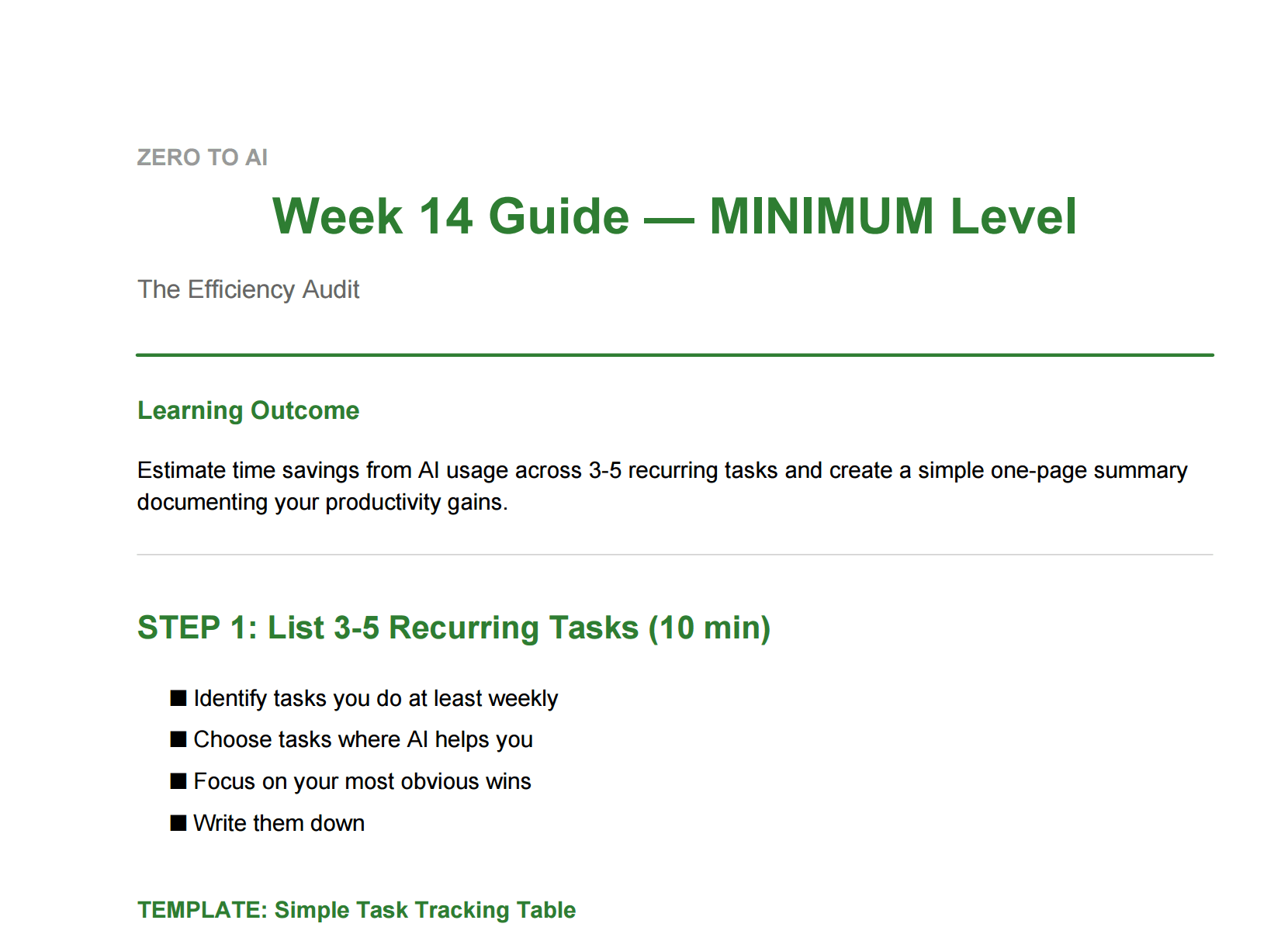
Minimum Level – 60 Minutes
Pick three to five recurring tasks you do regularly. For each one, estimate time before AI versus after AI. Write a simple one-page summary showing total time saved per week and what that enables you to do differently. Focus on your most obvious wins.
Sixty minutes. You’ve got a documented efficiency audit.
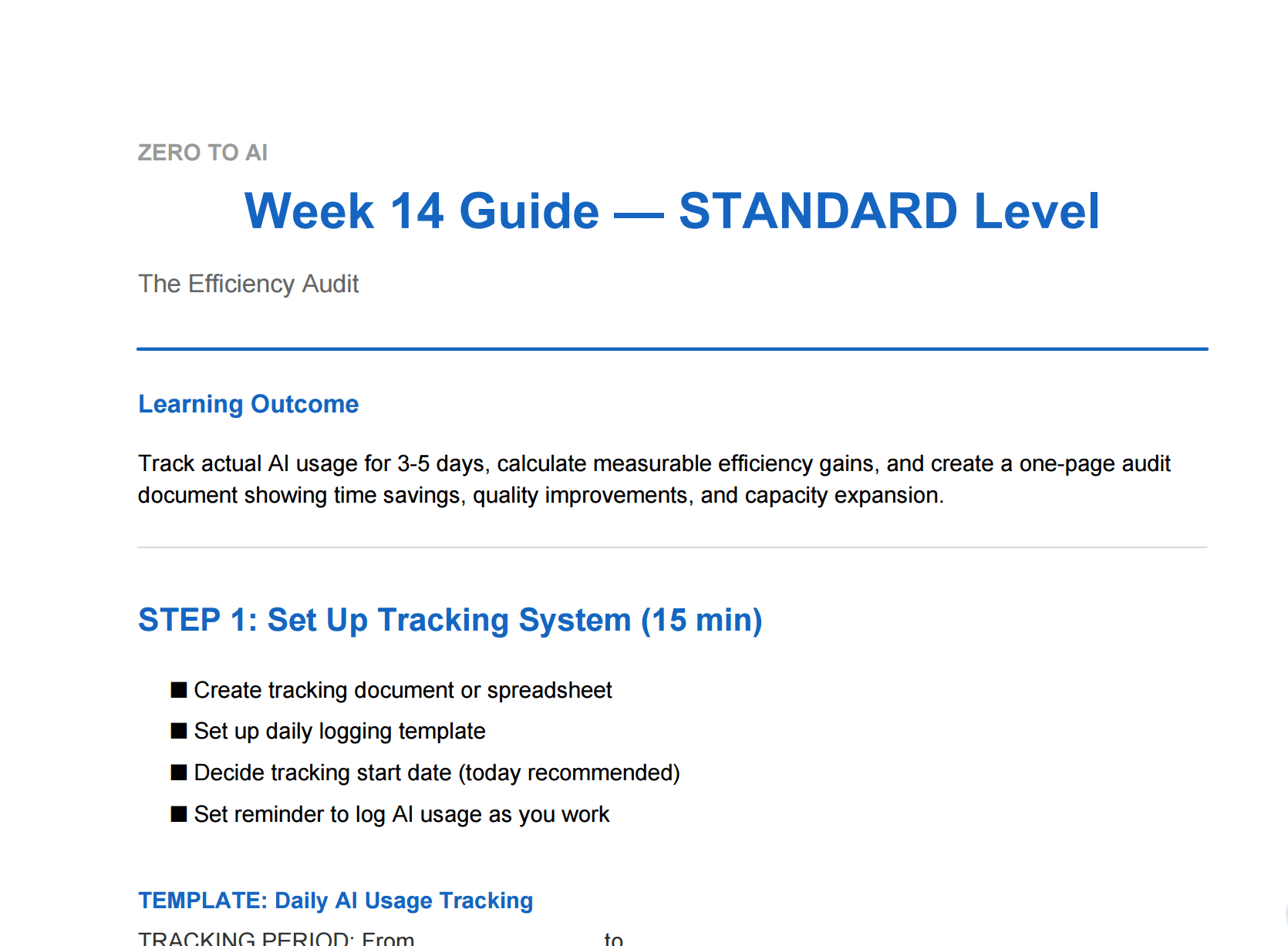
Standard Level – 2 Hours
Track your actual AI usage for three to five days. Every time you use AI, note: what for, time saved, quality impact. Then calculate weekly and annual time savings. Create a one-page efficiency audit showing time savings, quality improvements, capacity expansion, and your new value proposition statement.
This is what you show your boss. Two hours. You’ve got performance review ammunition.
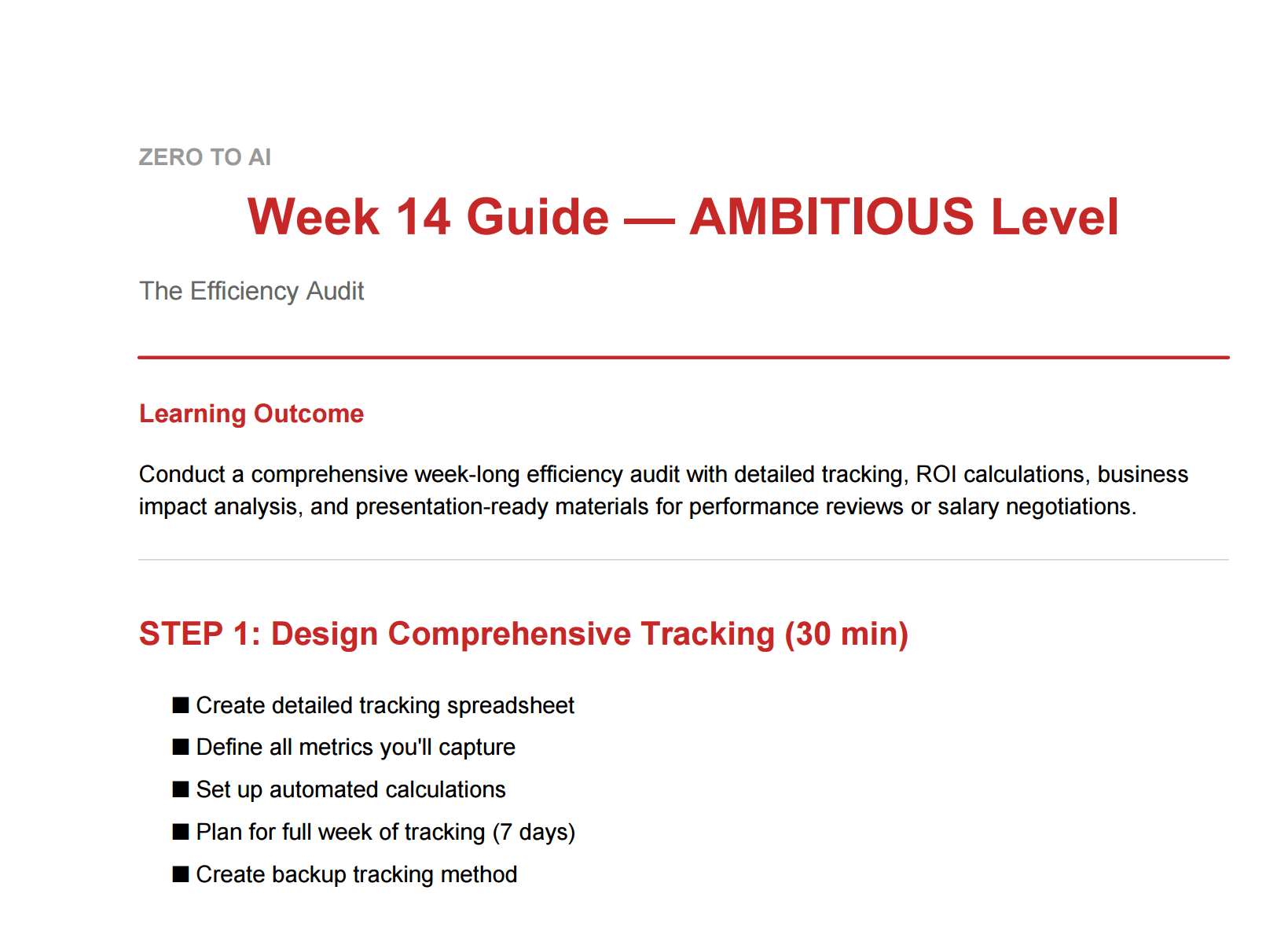
Ambitious Level – 4 Hours
Conduct a comprehensive week-long audit tracking every AI interaction. Document time savings, quality improvements, errors prevented, new capabilities gained. Create a detailed efficiency report with before/after metrics, dollar value calculations using your hourly rate, business impact translation, and specific examples. Build presentation-ready materials for performance reviews or salary negotiations.
Four hours. You’ve got a business case for your own value.
All three levels are legitimate. Choose based on what you need and what time you have.
Your Action Plan
Here’s your action plan for this week.
First: Go to zerotoai.co.nz/week-14 and download your chosen guide. Minimum, Standard, or Ambitious.
Second: Complete your audit this week. If you’re doing Standard or Ambitious, start tracking today. Don’t wait until Sunday and try to remember what you did all week. Track as you go.
Third: Calculate your value-add. Time saved. Quality improved. Capacity expanded. Dollar value if you can. Make it concrete.
Fourth: Save the completed guide to your portfolio folder. This sits next to last week’s signature project. You’re building a collection of evidence.
Wrapping Up
This is your second piece of evidence.
Week thirteen, you built something impressive. Week fourteen, you prove it’s not a fluke. You measure your productivity gains. You document them. You connect them to business value.
Next week, week fifteen, you’re going to document your AI stack. How you actually work. Your system. Your workflows. That’s the guide you share when people ask, “How do you use AI?”
But right now, focus on week fourteen. Pick your level. Download your guide. Track your efficiency. Document it.
By the end of this week, you’ll know exactly how much value AI is adding to your work. Not guess. Know.
And that’s powerful.
This article is part of the Zero to AI series. Visit zerotoai.co.nz for guides, templates, and more.